




-3.png?width=2000&name=Untitled%20design%20(1)-3.png)



RFID vs. NFC Explained: Range, Frequency, and Use Cases
Summary • 15 minutes read
Share


-4.png?width=1062&name=RedBeam%20Blog%20Photos%20(1000%20x%20600%20px)-4.png)
You're deep into reviewing a tracking system when radio frequency identification (RFID) and near-field communication (NFC) show up on the spec sheet. The same thing happens when you compare access badges and payment terminals. Suddenly you're searching RFID vs. NFC and wondering if it's one technology or two.
The reality? They're related. NFC is a specialized form of RFID built for close-range, two-way communication at 13.56 MHz. Broader RFID spans multiple frequency bands built for bulk reads at distance. They're related, but they're not the same. Confusing the two leads to mismatched hardware before your project even starts.
Knowing the difference lets you match the right frequency band to your warehouse, retail floor, or access control deployment. This way, you order the right hardware the first time.
Main Takeaways
- NFC is a subset of RFID, operating at 13.56 MHz with a max range of about 4 cm. It's a good fit for contactless payments and access badges.
- Ultra-high-frequency (UHF) RFID reads hundreds of tags per second from over 12 meters away. It's the common choice for warehouse and logistics tracking.
- Tags are either passive (powered by the reader) or active (battery-powered, readable past 100 meters). Passive UHF covers most asset and inventory tracking.
- Smartphones read NFC and some high-frequency (HF) RFID tags at 13.56 MHz only. Low-frequency (LF) and UHF tags require dedicated hardware.
- NFC's short range is a deliberate security feature, but relay attacks are a real threat that tokenization and transaction limits help address.
- Many retail and facility operations use both UHF RFID for inventory counts and NFC for payments or access control in the same building.
|
Pick the Right RFID Tag for Every Job Each RFID tag type fits a specific setting and read range. This guide breaks down the differences so you order the right hardware the first time. |
What Is RFID and What Is NFC?
RFID (radio-frequency identification) uses radio waves to identify and track tagged objects without line-of-sight contact. NFC (near-field communication) is a specialized subset of that same technology, designed for deliberate, two-way exchanges at very short range. Knowing how RFID and NFC relate keeps you from treating them as the same when they serve very different jobs.
What Is RFID?
RFID works by sending radio waves from a reader to a tag on an object. The tag responds with a unique identifier, and the reader logs it. No barcode alignment or line of sight is needed.
RFID is a broad family, not a single technology. It covers low-frequency animal microchips and high-frequency library cards. Ultra-high-frequency (UHF) gate readers scan hundreds of warehouse pallets in seconds. The common thread across every RFID variant is wireless identification without seeing or touching the tag.
A working system has four parts: the tag, an antenna, a reader, and the host software that turns each read into a record. The first three are hardware decisions you make once. The fourth is where the data becomes useful, and it's the part most deployments underestimate.
What Is NFC?
NFC (near-field communication) is a subset of RFID that operates at 13.56 MHz with a max range of roughly 4 cm. That short range is deliberate: it ensures you start every exchange by tapping or holding your device close. It adds two-way communication so both devices can send and receive data in a single exchange.
NFC powers tap-to-pay terminals (Apple Pay, Google Pay), access badges, and Bluetooth device pairing. It also stores more than an ID number. An NFC tag can hold a URL, a credential, or a trigger that launches an app, which is why it works for maintenance logs and check-in workflows. It feels more familiar than "RFID" because it's built into every modern smartphone. But when you compare RFID versus NFC, you're really comparing the whole category against one specialized product within it.
RFID Frequency Types and Where NFC Fits
RFID operates across three main frequency bands. NFC sits within one of them. The band you choose sets your read range, how many tags you can scan at once, and whether a smartphone can do the job. Picking the wrong frequency means buying hardware that doesn't match your environment.
Low Frequency (LF): 125 to 134.2 kHz
LF RFID reads at very short range (under 10 cm) and handles one tag at a time. Its strength is reliability near metal and liquids, which makes it the standard for animal identification. For example, the US Department of Agriculture (USDA) now requires readable eartags for cattle and bison. Those tags typically use LF at 134.2 kHz per ISO 11784/11785.
High Frequency (HF) and NFC: 13.56 MHz
HF RFID and NFC share the same 13.56 MHz frequency, but they're designed for different jobs. HF RFID uses that frequency to handle library book tracking and laundry management. Your smartphone's NFC chip uses it for Apple Pay, Google Pay, and badge taps. NFC adds two-way communication and strict short-range limits (4 cm or less). That's what makes it the standard for contactless payments and access badges rather than bulk inventory reads. If you're reviewing NFC frequencies for a deployment, 13.56 MHz is the only band you'll work with.
Ultra-High Frequency (UHF): 860 to 960 MHz
UHF RFID (often called RAIN RFID) operates between 860 and 960 MHz using the EPCglobal Gen 2 (ISO/IEC 18000-63) standard. It reads tags from over 12 meters away and can scan hundreds of items at once. This is the technology behind dock-door portals, inventory cycle counts, and asset tracking at scale.
UHF adoption is growing fast: 52.8 billion RAIN tag chips shipped globally in 2024, up 54% from 2022, according to the RAIN Alliance. That volume signals maturing systems and falling per-tag costs for operations teams reviewing RFID or NFC for their next deployment.
Active or Passive: The Other Choice That Sets Your Range
Frequency isn't the only thing that determines how far a tag reads. Tags are either passive or active, and the difference is a battery.
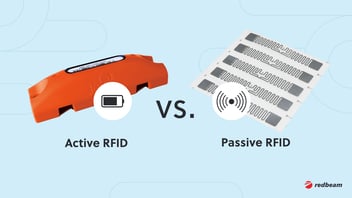
Passive tags have no power source. They draw energy from the reader's signal, respond with their identifier, and go quiet. They're inexpensive, they last for years, and they cover the vast majority of asset and inventory tracking work. Every tag we've covered so far is passive.
Active tags carry their own battery. That extra power pushes read range past 100 meters and lets the tag broadcast on its own schedule. It also means a larger tag, a higher per-unit cost, and a battery you eventually have to replace. Active tags earn their cost in a narrow set of cases, like tracking shipping containers across a yard or monitoring high-value equipment that moves across a large site.
For fixed asset tracking, inventory counts, and work-in-progress visibility, passive UHF is the practical choice. You get the read distance you need at a per-tag cost that scales to thousands of items. That's the model we're built on.
RFID vs. NFC at a Glance: How Do the Two Compare?
The table below puts the three RFID bands and NFC side by side, so you can match a frequency to your read range, tag volume, and hardware before you order anything.
|
Attribute |
LF RFID |
HF RFID |
UHF RFID |
NFC |
|
Frequency |
125 to 134.2 kHz |
13.56 MHz |
860 to 960 MHz |
13.56 MHz |
|
Typical range |
Under 10 cm |
Up to 1 m |
Up to 12+ m |
4 cm or less |
|
Tag power |
Passive |
Passive |
Passive or battery-assisted |
Passive |
|
Data flow |
One-way |
One-way or two-way |
Read and write |
Two-way |
|
Data stored |
Basic ID |
Basic ID |
ID plus limited user memory |
URLs, credentials, app triggers |
|
Multi-tag reading |
No |
Limited |
Yes, hundreds at once |
No |
|
Smartphone compatible |
No |
Partial |
No (Requires Enterprise RFID Hardware) |
Yes, built into phones |
|
Typical hardware |
Embedded readers |
Handheld readers |
Fixed readers (e.g., Zebra FX Series), enterprise handhelds with built-in readers, RFID sleds, portals |
Phone or terminal |
|
Security model |
Basic |
Moderate, ISO 14443 |
Varies by implementation |
Encryption and tokenization, ISO 14443 |
|
Common use cases |
Animal microchips, access fobs |
Library cards, laundry tags |
Inventory tracking, asset tracking, logistics |
Contactless payments, access badges, device pairing |
The real-world split is simple. Tracking pallets through a warehouse dock door calls for UHF RFID. Tapping a badge or phone at a payment terminal means you're using NFC.
Which Should You Choose for Your Use Case: RFID or NFC?
Your environment, read volume, and whether users start the exchange determine which technology fits. Here's the pick for four common deployments.
Manufacturing and Logistics
If you need to track work-in-progress, tools, or finished goods across a production floor, choose UHF RFID. Fixed enterprise readers (such as the Zebra FX Series) integrated with RedBeam middleware at dock doors and staging areas deliver high-speed multi-tag filtering without slowing throughput or overloading core ERP systems. You'd be in good company adopting UHF RFID, too. A 2024 Zebra Technologies study found that 66% of manufacturing leaders plan to add RFID within five years to close visibility gaps.
Putting that visibility into practice requires software that turns every read into useful data. We connect UHF RFID reads to your asset records in real time. Your team sees location and status updates without manual data entry. With 3,500+ deployments and over 2 billion RFID reads processed, that link is proven at production scale.
Retail Inventory and Asset Tracking
For store-level inventory counts and fixed asset tracking, UHF RFID lets a single worker scan an entire stockroom in minutes. For customer-facing checkout, NFC handles tap-to-pay at the terminal. Many retail operations use both technologies in different parts of the same building.
Access Control and Payments
For building access, employee badges, and secure-area entry, NFC or HF RFID is the standard. The short range ensures the user presents the credential on purpose. Two-way communication supports encrypted authentication per ISO/IEC 14443.
For contactless payments, NFC is the only practical choice. Its short range and tokenization make it the secure, user-started standard behind Apple Pay, Google Pay, and tap-to-pay cards. No RFID band outside 13.56 MHz supports the two-way encrypted exchange payment networks require.
Government, Schools, and Public Agencies
State and local agencies and school districts track a mix that doesn't fit one band. Laptops and tablets move between buildings and students. Vehicles, radios, and field equipment leave the property and come back. Furniture and fixtures sit still for years but still show up on an annual audit.
UHF RFID handles the audit problem. One person walking a building with a handheld reader can count a room in seconds instead of matching serial numbers against a spreadsheet. That matters most when the count has to hold up to an external review.
NFC or HF RFID covers the access side: staff badges, secure rooms, and check-in and check-out for shared devices. Most agencies end up running both, which is normal. The two bands don't interfere, and a single tracking system can record reads from either one.
|
See How UHF RFID Fits Your Operation Warehouses, retail floors, and production lines each have different read-volume and hardware requirements. Evaluate how RedBeam handles fixed readers, mobile devices, and dock-door workflows. |
Security, Smartphone Limits, and What They Mean for Your Deployment
Security and device support are the two factors most likely to derail a deployment after you've chosen the right frequency. Checking both before you order hardware saves you from costly swaps down the road.
Enterprise Security Risks and Safeguards
NFC's short range acts as a built-in security layer because an attacker needs to be within centimeters to steal a transaction. Range alone isn't enough, though. Research into Europay, Mastercard, Visa (EMV) contactless payment systems flags relay attacks as a real threat class. In a relay attack, an attacker bridges two NFC devices remotely.
Key safeguards include:
- Tokenization
- Transaction limits
- Risk-management protocols at the payment network level
A 2022 IEEE Symposium on Security and Privacy paper documents both the attack and the protections that hold up against it.
UHF RFID's longer range creates a different risk profile: unwanted reads from a distance. Enterprise safeguards include encrypted tag memory, role-based access controls in your tracking software, event logging, and physical shielding in sensitive areas. The security model you need depends on the frequency band you deploy. Scope your threat model alongside your hardware.
Can Your Smartphone Replace an RFID Reader?
Your smartphone can read NFC tags and some HF RFID tags at 13.56 MHz within about 4 cm. It can't read LF animal tags or UHF warehouse tags. Those frequencies require dedicated hardware. The limit is frequency-based: phones are built for 13.56 MHz only.
For bulk inventory reads or asset tracking at scale, a phone alone won't cover it. UHF deployments require enterprise mobile computers with built-in readers (such as the Zebra MC3300 RFID series), dedicated RFID sleds (such as the Zebra RFD40 or RFD90), or fixed portal antennas. We run exclusively on field-proven Zebra Technologies devices as a Zebra Premier ISV Partner, so the reader in your team's hands and the software recording the read are built to work together. Backed by 20+ years of data capture experience, every scan connects to your asset records without anyone bridging the gap by hand.
Start Tracking with Confidence Using RedBeam RFID
You can now tell whether NFC's tap-and-go simplicity or RFID's bulk-read speed fits your operation. Match the right frequency band to your environment. Avoid the mismatched hardware purchases that delay deployments and waste budget. The decision comes down to range, read volume, and user intent.
We connect RFID readers to your asset and inventory records in real time. Your team sees location updates, cycle count results, and compliance audit trails without manual data entry. One process covers every dock door, stockroom, and production line. That's Tracking Made Easy™.
|
Connect UHF Reads to Your Asset Records Your dock doors and stockrooms can feed real-time data straight into your back-office systems. See how RedBeam deploys RFID across warehouses, retail floors, and manufacturing operations. |
FAQs About RFID vs. NFC
Are Credit Cards NFC or RFID?
Contactless credit cards use NFC. They operate at 13.56 MHz with a max read range of about 4 centimeters via the ISO/IEC 14443 protocol. That tap-to-pay behavior is NFC's defining trait. The short range and two-way communication enable the tokenization and encryption that make contactless payments secure.
Is Apple Wallet NFC or RFID?
Apple Wallet uses NFC. It operates at 13.56 MHz with the same short-range, user-started tap that all phone-based payment systems require. Apple Pay, Google Pay, and Samsung Pay all rely on the NFC chip in modern smartphones. The technology is NFC, not broader RFID, because it requires two-way communication and a deliberate tap.
Which Is Better for Payments, NFC or RFID?
NFC is the only practical choice for contactless payments. It requires close-range, user-started taps within 4 centimeters. Two-way encrypted communication works with the tokenization standards payment networks require.
Are Key Fobs RFID or NFC?
Most building access fobs use RFID, usually low frequency at 125 kHz or high frequency at 13.56 MHz. Newer access systems increasingly use NFC so employees can carry credentials on a phone instead of a separate fob. If your fob works with a phone tap, it's NFC.
Are Animal Microchips RFID or NFC?
Animal microchips use low frequency RFID, typically at 134.2 kHz under the ISO 11784 and ISO 11785 standards. They aren't NFC, which is why a smartphone can't scan a pet's chip. Veterinary offices and shelters use dedicated LF readers.
Do I Need RFID Blocking Protection?
For a phone, no. Your phone's NFC chip only transmits when you unlock the device and start a transaction. For physical contactless cards, a blocking sleeve or wallet reduces the already small risk of a skimming attempt, since those cards respond to any compatible reader within a few centimeters. For enterprise UHF deployments, the equivalent safeguard is encrypted tag memory and physical shielding in sensitive areas, not consumer blocking products.
Do I Need Different RFID Readers for Different Frequency Bands?
Yes. LF, HF, UHF, and NFC each require readers designed for that specific frequency. A UHF gate reader can't scan an NFC badge, and a smartphone can't read a UHF warehouse tag. Some handheld readers support multiple HF-range protocols, but no single device covers all four bands. Scope your use case and frequency before ordering hardware to prevent costly mismatches.
%20(1)-3.png?width=352&name=RedBeam%20Blog%20Photos%20(1000%20x%20600%20px)%20(1)-3.png)