





-3.png?width=2000&name=Untitled%20design%20(1)-3.png)


RFID in Manufacturing Explained: Uses, Costs, and ROI
Summary • 19 minutes read
Share


%20(2)-2.png?width=1062&name=RedBeam%20Blog%20Photos%20(1000%20x%20600%20px)%20(2)-2.png)
A part is somewhere on your floor. Your enterprise resource planning system (ERP) says it's at Station 2. Your operator says it left an hour ago. Nobody knows where it is now, so the next station waits. That's a visibility problem, and it compounds every shift. It's also far too common in today's manufacturing operations.
Enter radio-frequency identification (RFID). RFID in manufacturing closes that gap at floor level. It lets you track parts, tools, and assets through every production stage without manual scanning or line-of-sight reads.
RFID earns its place by feeding your ERP or warehouse management system (WMS) accurate, real-time data that barcodes and manual entry can't produce. When floor events update your records on their own, production stays on schedule, and the lost time, duplicate purchases, and failed audits that come from stale data start to disappear.
Main Takeaways
- Passive ultra-high-frequency (UHF / RAIN) RFID handles most manufacturing use cases because it reads hundreds of tags per second without line-of-sight scanning.
- Tag selection depends on surface material and environment. Standard labels fail on metal, on-metal tags fix that cheaply, and rugged tags handle heat, chemicals, and outdoor exposure.
- RFID feeds your existing ERP or WMS through middleware and REST APIs, updating work order status and inventory counts on its own.
- WIP tracking, inventory management, kitting, tool tracking, and quality traceability are the five core use cases where RFID replaces manual data entry on the floor.
- A single-line WIP pilot is the fastest path to a payback number your finance team will accept, because the labor it displaces is measurable before you scale.
|
Pick the Right RFID Tag for Every Surface Tag selection is where most pilots stumble. This guide covers how passive, active, and semi-passive tags differ and what each type is built to handle. |
Types of RFID Systems and Key Components
RFID systems in manufacturing split into three categories. The dividing line is simple: how the tag gets its power. That single difference sets read range, per-tag cost, and where each type fits on your floor.
Passive, Semi-Passive, and Active RFID
Passive RFID tags carry no battery and draw power from the reader's signal. Semi-passive tags use a battery to power the chip and any onboard sensors, but they still rely on the reader's signal to communicate. Active RFID tags contain a battery-powered transmitter that broadcasts continuously, reaching 300 feet or more. The table below shows how those differences affect cost and manufacturing fit.
|
Type |
Power Source |
Typical Read Range |
Per-Tag Cost |
Best Manufacturing Fit |
|
Passive RFID |
No battery; powered by reader signal |
Up to 30+ ft (UHF) |
$0.04 to $0.25 |
WIP tracking, inventory, item-level tagging |
|
Semi-Passive (BAP) RFID |
Battery powers chip sensor; reader signal powers communication |
Up to 100 ft |
$2 to $15 |
Temperature and humidity monitoring during process or storage |
|
Active RFID |
Battery-powered transmitter |
300+ ft |
$15 to $50+ |
Real-time location of high-value mobile assets across large facilities or yards |
As an enterprise RFID solution provider, RedBeam standardizes on passive UHF (RAIN RFID) for floor operations because it strikes the best balance of cost, read range, and scalability. The RAIN Alliance reported 52.8 billion passive UHF tag chips shipped globally in 2024, up 54% from 2022. The volume reflects how broadly manufacturers have adopted passive tags for high-volume, multi-station tracking.
System Components and Tag Selection
Every RFID setup relies on four components working together:
- Tags
- Antennas
- Readers
- Software and middleware
Tags are the data carriers you attach to parts, pallets, tools, or containers. Each tag holds a chip with a unique ID (and optional sensor data) plus an antenna that transmits and receives RF energy. Antennas shape or direct the reader's RF field. Portal-style setups use multiple antennas to cover a full doorway or conveyor zone.
Fixed RFID readers (such as enterprise-grade Zebra FX series) mount at doorways, conveyor stations, or dock doors to capture tags automatically. Mobile handheld readers (like Zebra MC3300R series) allow operators to perform on-demand cycle counts, audits, or receiving. Software and middleware sit between the readers and your material requirements planning (MRP), ERP, or WMS. They filter raw reads, remove duplicates, and push structured events into your business systems.
The tag itself matters just as much as the hardware around it. Standard UHF inlays work well on cardboard, plastic, and wood. They fail on metal and in extreme conditions. Matching the right tag to your environment keeps read rates high and replacement costs low. The chart below describes how to do just that.
|
Condition |
Tag Solution |
|
Metal surfaces |
On-metal hard tags with spacer |
|
High heat (autoclave, curing) |
Ceramic or high-temp encapsulated tags rated 200°C+ |
|
Chemicals and washdown |
IP68-rated enclosures |
|
Outdoor yards and cold storage |
Ruggedized encapsulated tags with extended temp range |
Tag cost rises with durability. Standard UHF labels land at the low end of the passive range above. On-metal tags run $0.75 to $5.00, and rugged or encapsulated tags built for heat, chemicals, or outdoor exposure run $3.00 to $15.00. Match the tag to the asset's value and the conditions it faces. That way you avoid overspending on labels that don't need to survive a furnace.
Core Manufacturing Use Cases for RFID
RFID earns its place on the manufacturing floor by solving five problems at once: tracking WIP through production, keeping inventory counts accurate, verifying kits before assembly, locating tools and assets, and building an automatic audit trail for quality and traceability. Each one replaces a manual step that someone is doing today.
WIP Tracking
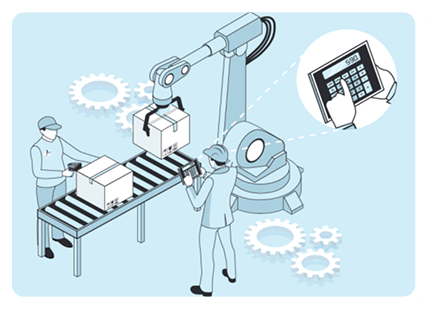
The station-by-station sequence is simple. You tag a part or carrier at the first workstation. Fixed readers at each later station capture the tag as the part arrives and departs. Every read triggers a status update like "at Station 3, welding complete."
Middleware formats each read and pushes it to your manufacturing execution system (MES) or ERP, which applies your routing logic and updates the work order. The routing decisions stay where they already live. What changes is that the system knows where the part actually is, in the moment, without an operator stopping to scan and type.
That automatic flow is where RFID replaces the manual scan-and-enter process that lets WIP data go stale. As parts move between stations, every read becomes a timestamped production event.
The gap this closes is wide. Only 16% of manufacturers globally have real-time visibility into production today, yet 66% plan to adopt RFID within five years, according to a 2024 Zebra study. Parts are on the floor. Nobody knows where until someone walks out and checks.
Inventory Management
Fixed portal readers at dock doors and staging areas capture inbound and outbound movements on their own. They update inventory counts in your ERP or WMS without manual scanning. A food and beverage manufacturer, for example, tags raw-material containers at receiving. Portal reads at the warehouse entrance and production staging area keep lot-level counts accurate without cycle-count labor. The result: fewer stockouts, fewer duplicate purchases, and cycle counts that take hours instead of days.
The bigger win is upstream. Line-down events usually trace back to a material that didn't arrive, or arrived and got misplaced, and nobody knew until the line stopped. When suppliers tag at their end and your portals read at yours, inbound materials show up in your system the moment they cross your dock rather than whenever someone gets to the paperwork. You find out about a short shipment while there's still time to react.
Kitting Verification
Kits fail quietly. A component is missing or wrong, nobody catches it at the kitting station, and the problem surfaces at assembly with a line already waiting.
An RFID-enabled kitting station reads every tagged component in the bin at once and checks it against the bill of materials. A missing part or a substituted component flags before the kit leaves the station. The check takes no operator time, because the read happens as the kit passes the antenna rather than as a separate verification step.
This matters most where kits are complex, where components look alike, or where a wrong part isn't obvious until it's installed. Those are the same conditions that make manual verification slow and unreliable.
Asset and Tool Tracking
Shared tools, test equipment, jigs, and fixtures move between lines, departments, and shifts. When they go missing, you get duplicate purchases and downtime while operators search. Tagging high-value tools with durable on-metal tags and placing fixed readers at tool cribs and department exits logs every checkout and return.
Calibration is where this pays off beyond convenience. Calibrated instruments like torque wrenches, gauges, and test equipment carry a due date, and using one past that date can invalidate the work it touched. Tracking those dates in a spreadsheet means someone has to remember to check it. With the tool tagged and the calibration date tied to its record, the system flags an overdue instrument before it's used and shows you which parts passed through it since the last valid calibration. In a regulated operation, that second capability is the one auditors ask about.
Quality Control and Traceability
Every RFID read creates a timestamped record tied to a serial number, work order, and station. Over the course of production, that builds a digital genealogy for every part. During a recall or quality event, you isolate the affected batch by querying which parts passed through a specific station during a specific time window. You don't pull entire production runs.
An automotive Tier 1 supplier using RFID-logged station data can trace a defective component back to the exact press and shift. That limits the recall scope to 200 parts instead of 5,000. Across all five use cases, the common thread holds: RFID turns floor events into system records on its own. Your team spends time acting on data instead of collecting it.
|
Stop Waiting on Manual WIP Status Updates When parts move through stations without automatic reads, your ERP falls behind and bottlenecks stay hidden. See how automated WIP monitoring closes that gap. |
RFID vs. Barcode vs. QR Code in Manufacturing
RFID outperforms barcodes and QR codes in manufacturing environments where you need bulk reads, no line-of-sight scanning, and automatic data capture. Barcodes still make sense for low-volume, low-cost uses where a single scan per item is fast enough.
The right choice depends on your read volume, environment, and budget.
|
Dimension |
RFID (UHF Passive) |
Barcode |
QR Code |
|
Line of sight required |
No |
Yes |
Yes |
|
Read speed (items/sec) |
100+ simultaneously |
1 at a time |
1 at a time |
|
Bulk scanning |
Yes (portal or overhead) |
No |
No |
|
Durability in harsh environments |
High (encapsulated tags) |
Low (print degrades) |
Low (print degrades) |
|
Data capacity |
96 to 496 bits (EPC) |
~20 characters |
~4,000 characters |
|
Per-unit cost |
$0.04 to $15 (varies by tag type) |
$0.01 to $0.05 |
$0.01 to $0.05 |
|
Read/write capability |
Read and write |
Read only |
Read only |
RFID wins when you're tracking hundreds of items through stations or portals without stopping, and when tags face heat, chemicals, or metal. It's also the right pick when you need automatic reads without operator action. Barcodes are enough for low-volume receiving, finished-goods labeling, or single-item lookups where cost is the primary concern. Many manufacturers run a hybrid setup: RFID for WIP and high-value assets, barcodes on finished goods and shipping labels. Let the use case dictate the technology.
How RFID Data Flows into Your ERP, MRP, or WMS
RFID doesn't replace your ERP, MRP, or WMS. It feeds them. The data path runs from tag read to reader to middleware to your business system. Specific fields update in real time so your records match your floor.
Here's how that flow works step by step:
- Tag read. A tagged part passes a fixed reader at a workstation or portal.
- Reader capture. The reader logs the tag's unique ID, the reader's location, and a timestamp.
- Middleware processing. Middleware on an edge server filters duplicate reads and applies business rules. For example: "If Station 4 reader, update status to 'assembly complete.'"
- API push. The formatted event pushes to your ERP, MRP, or WMS via REST API, updating fields like item ID, location, timestamp, work order number, production status, and quantity.
GS1 EPCIS 2.0 (ISO/IEC 19987) and EPC Gen 2 (ISO/IEC 18000-63) standards define how tag data and operational events are structured and shared across enterprise platforms. Those standards make multi-system and multi-site integration more reliable because every reader and middleware layer speaks the same event language.
When this flow is running, your ERP's work order status updates without a manual entry. Your WMS inventory counts adjust as parts move through portals. MRP demand signals reflect actual consumption, not yesterday's cycle count. RedBeam integrates natively with Zebra readers via the Zebra IoT Connector, absorbing and normalizing high-volume edge data before pushing structured REST API events into your ERP or WMS with no rip-and-replace required.
The common blocker isn't the technology. It's getting IT and OT teams aligned on data ownership, event logic, and where to invest. One-third of manufacturing leaders cite that alignment gap as a key barrier to digital transformation, per the same Zebra study. Two things move that conversation faster than anything else. The first is a security answer IT can verify, which for us is a SOC 2 Type II certified platform built on Google Cloud. The second is evidence the integration has been done before, which for us is 3,500+ deployments and over 2 billion RFID reads processed.
Implementation Steps, Costs, and ROI
A typical RFID rollout for a mid-size manufacturing plant follows five steps: scope, pilot, hardware selection, integration, and scale. The point of running them in that order is that each one produces a number the next one needs.
Getting Started: Scope Through Scale
Step 1: Scope. Identify your highest-pain use case, usually WIP or tool tracking. Map the read points (stations, portals, tool cribs) and define which system fields need updating.
Step 2: Pilot. Tag 50 to 200 items in one zone or line. Install two to three fixed readers and confirm read rates, data flow, and middleware rules before committing to full deployment. Run a joint IT and OT design review at this stage. That alignment step prevents the ownership gap that stalls a third of digital transformation programs.
Step 3: Hardware selection. Match tags to your environment using the condition-to-tag guidance above. Select enterprise Zebra fixed readers or mobile RFID handhelds based on process flow, and plan antenna placement for coverage without dead zones.
Step 4: Integration. Configure middleware rules and API connections to your ERP, MRP, or WMS. Test end-to-end data flow from tag read to system update.
Step 5: Scale. Expand to more lines, facilities, or use cases based on pilot results. Refine business rules as you add read points.
What It Costs and Where ROI Lands
There's no single price for an RFID deployment, and any vendor who quotes one before walking your floor is guessing. What you can do is build your own estimate. The table below gives vendor-neutral ranges for a mid-size plant pilot, and the section after it shows how to turn those into a payback number.
|
Component |
Typical Cost Range |
|
Passive UHF tags (bulk) |
$0.04 to $0.25 per tag ($0.75 to $5.00 on-metal, $3.00 to $15.00 rugged) |
|
Fixed readers |
$1,000 to $4,000 per reader |
|
Handheld readers |
$1,500 to $3,000 per unit |
|
Antennas (if separate) |
$150 to $300 per antenna |
|
Software and middleware, including ERP or MES connection |
$5,000 to $50,000+ (varies by scope and licensing model) |
|
Integration and professional services |
$10,000 to $50,000+ (depends on ERP complexity) |
These ranges cover a manufacturing deployment with middleware and a connection to your ERP or MES. A general asset tracking deployment without that integration layer costs less. See our RFID cost breakdown for those figures.
Building Your Own Payback Number
Rather than trusting a published payback range, run the arithmetic against your own operation. Three use cases give you the clearest math.
WIP status updates. Count the stations on the line you're considering. Estimate the minutes per shift your operators currently spend scanning and keying status at each one, then multiply by shifts per year and loaded labor rate. That's your labor line. Add whatever a bottleneck costs you when it goes unnoticed for half a shift, since surfacing those in real time is the second half of the return. Compare against tags for the parts on that line plus readers for those stations.
Tool and asset search. Take your annual tool replacement spend and estimate what share of it is genuinely lost tools rather than worn ones. Add the labor hours your team spends looking. A meaningful reduction in either number, against a tool crib's worth of hard tags and two or three readers, is usually the fastest payback in the plant because the hardware count is so low.
Cycle counts. Multiply the labor hours your current count consumes by how often you run it. Add the cost of the stockouts and rush shipments that stale counts cause. Weigh that against portal readers at your dock and staging areas plus tags on containers.
Run those three and one will be obviously better than the others. That's your pilot.
When RFID Isn't the Right Call
RFID isn't right for every operation, and knowing where it breaks down makes the case stronger where it holds.
Your parts are low-value and high-volume. A tag that costs a quarter on a component worth two dollars is hard to justify at item level. Tagging the carrier or tote instead of the part often fixes this, but if you need part-level visibility on cheap parts, the math may not close.
Your environment is almost entirely metal. On-metal tags solve interference, but they cost several times a standard label. Run that premium across your full tag count before committing.
Your ERP can't take the data. A legacy system without documented APIs turns integration from configuration into custom development, and that cost can exceed the hardware. Find out what yours supports first.
Your volume is low enough that barcode already works. RFID's advantage is bulk, automatic reads. If a handful of scans per shift keeps your records current and nobody is waiting, barcode is the right tool at a fraction of the cost.
If one of these describes your operation, run a smaller pilot on the strongest use case and let the results decide the rest.
Start Tracking Assets and WIP with RedBeam
You now have a framework for choosing the right RFID system type and mapping it to WIP, kitting, or asset tracking use cases. From here, you can connect it to your ERP or WMS so floor events update your records without manual entry. The technology is proven, the costs are knowable, and a single-line pilot is small enough to justify without a committee.
We built RedBeam to connect Zebra RFID readers to the ERP, MRP, or WMS platforms you already run. Real-time reads push through REST APIs without forcing you to replace your core systems. One process covers every line, station, and facility, so you can prove WIP status, inventory accuracy, and asset location with data your audit team will accept. That's Tracking Made Easy™.
|
Connect Your Floor Reads to Your ERP Today Tools going missing between shifts and stale work order data are fixable problems. A single-line pilot with Zebra readers and REST API integration can prove it fast. |
FAQs About RFID in Manufacturing
How Long Does It Take to Deploy an RFID System in a Manufacturing Plant?
Most mid-size operations complete a pilot in four to eight weeks. That covers hardware install, middleware setup, and ERP integration for one line or zone. Scaling to more areas usually takes three to six months after that. API setup and IT and OT alignment take longer than the physical install, so plan for that first.
Can I Use RFID Alongside Barcodes Instead of Replacing Them Completely?
Yes, and most manufacturers do exactly that. RFID handles high-volume, automated tracking like WIP and shared tools. Barcodes stay on finished goods, low-value items, or processes where per-unit cost matters more than read speed. It's a practical split. We support both RFID and barcode workflows in the same platform, so you don't have to choose one system for everything.
What Happens if an RFID Tag Fails or Gets Damaged on the Production Floor?
If a tag fails mid-process, your middleware flags the missing read as an exception. It alerts operators to verify the part's status or apply a replacement tag before it moves on. That keeps bad data out of your ERP without stopping the line. Exception handling is a standard middleware feature. Encapsulated tags rated for harsh environments also cut failure rates sharply in most conditions.
How Do I Know if My Facility's Metal Surfaces and Machinery Will Interfere with RFID Reads?
Metal surfaces reflect and absorb RF signals, which blocks reads from standard UHF labels. On-metal tags with built-in spacers solve this by creating distance between the tag antenna and the metal surface. The interference is predictable and fixable with the right tag type. Your pilot phase should include read-rate testing at actual workstations and on real assets. Antenna placement and reader power settings also affect read rates in metal-heavy zones, so confirm both before you scale.
Am I Locked into Specific Tags or Readers?
Not on tags. We support industry-standard EPC Gen 2 passive UHF tags from any compliant manufacturer, and our middleware normalizes the data before pushing it to your ERP, MRP, or WMS through REST APIs. Tag sourcing stays flexible, and EPC Gen 2 is the global standard, so you can buy competitively. For reader infrastructure, we recommend and standardize on enterprise Zebra hardware. RedBeam is engineered Zebra-first and integrates natively with the Zebra IoT Connector, ensuring software and readers are validated together to eliminate integration overhead.
%20(1)-4.png?width=352&name=RedBeam%20Blog%20Photos%20(1000%20x%20600%20px)%20(1)-4.png)
-4.png?width=352&name=RedBeam%20Blog%20Photos%20(1000%20x%20600%20px)-4.png)
%20(2)-1.png?width=352&name=RedBeam%20Blog%20Photos%20(1000%20x%20600%20px)%20(2)-1.png)